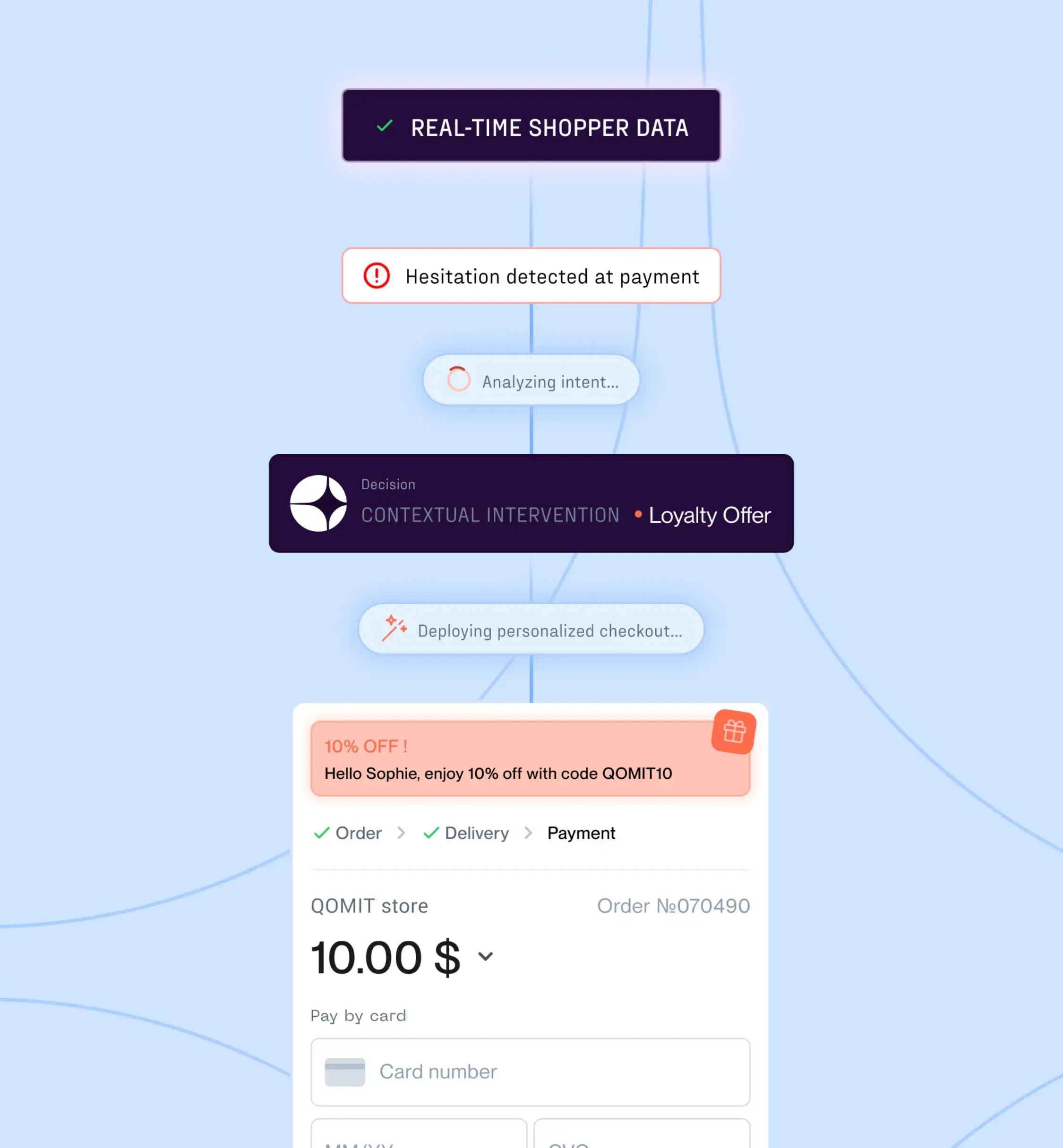
On a Monday morning, you look at your checkout data and you see it: on mobile, your shoppers hesitate right before payment. You know what would help, a small reassurance at that step. The only question left is how long before that change goes live.
Too often, the answer is measured in weeks. And by then, the trading week that mattered is gone.
This is the quiet tax on most checkout stacks. Not that they lack features, but that you cannot act at your own speed. Your checkout is operated for you, not by you. Every insight has to travel through someone else's backlog before it becomes a change.
We think that is the wrong shape. A checkout is a live commercial surface. The people who trade on it should be able to steer it directly.
That belief is what 26.7 puts into product. You now build and schedule your own contextual interventions, from templates, without code. You choose your checkout template rather than accept a single one. And where your shoppers used to stall, writing a gift message, an AI now offers the words.
None of this is sold on a promised number. Each of these is A/B testable, because the point is not to claim an uplift, it is to let you measure one.
The shift is subtle but structural: from a checkout you file requests against, to a checkout you operate. The last mile of your commerce stops being a black box someone else holds, and becomes a set of controls in your hands.